A little over three years ago, I entered the world of management consulting. Yesterday was my last day. In true consultant fashion, I sent the office a slide-as-farewell-email and enjoyed a few glasses of wine and a few bottles of beer with my “war-buddy” colleagues and other well-wishers at a local bar in the early evening. It was a great way to go.
What’s next? I now move from the world of advising large companies on big business issues to advising and, now also, investing in small, early-stage startups as someone in the venture capital space. This move won’t surprise many of my friends who have, for years, known me as someone with a lot of interest in startups and new technologies and who has dabbled on and off with my own little projects like Xhibitr. For me, a stint in VC was a great opportunity to get a chance to do many things, including:
I’m very excited and am looking forward to the next chapter of my professional life!
My younger brother Kevin is not only a great guy with a great sense of humor, but he’s a valued member of the Benchside team. Recently, my new Benchside teammate (and professional coder) Anuraag suggested that I start using the Python programming language’s formal exception handling system to handle errors gracefully rather than rely on Kevin/my cobbled together system of error handling which we pieced together for the purpose of getting stuff done rather than getting stuff done well. Anuraag’s suggestion was not a trivial change, although, admittedly, its something we should do as our code gets longer and more complicated, and when I raised the idea with Kevin, this is how he replied:
Kevin: man i hate exceptions
Me: aren’t u supposed to be the legit pro programmer?
Me: shouldn’t u have figured all this out before?
Kevin: my code doesnt make mistakes
Me: LOL
![]()
Kevin: thats why i dont need them
Sadly, while Kevin might not mistakes, I almost certainly do
.
I’ve mentioned Moore’s Law in passing a few times before. While many in the technology industry see the concept only on its most direct level – that of semiconductor scaling (the ability of the semiconductor industry, so far, to double transistor density every two or so years) – I believe this fails to capture its true essence. It’s not so much a law pertaining to a specific technology (which will eventually run out of steam when it hits a fundamental physical limit), but an “economic law” about an industry’s learning curve and R&D cycle relative to cost per “feature”.
Almost all industries experience a learning curve of some sort. Take the automotive industry – despite all of its inefficiencies, the cost of driving one mile has declined over the years because of improvements in engine technology, the building of the parts, general manufacturing efficiency, and supply chain management – but very few have a learning curve which operates on the same speed (how rapidly an industry improves its economic performance) and steepness (how much efficiency improves given a certain amount of “industry experience”) as the technology industry which can rely not only on learning curves but disruptive technological changes.
One of the best illustrations I’ve seen of this is a recent post on MacStories comparing a 2000 iMac and Apple’s new iPhone 4:
| 2000 iMac | 2010 iPhone 4 | |
| Processor | 500 MHz PowerPC G3 CPU | 1 Ghz ARM A4 CPU |
| RAM | 128MB | 512MB |
| Graphics | ATI Rage 128 Pro (8 million triangles) | PowerVR SGX 535 (28 million triangles) |
| Storage | 30GB Hard Drive | 32GB NAND Flash |
| Weight | 34.7 pounds | 4.8 ounces |
Although the comparisons are not necessarily apples-to-apples, they give a sense of the speed at which Moore’s Law progresses. Amazing, no?
Very provocative headline (see title of blog post) for an interesting WSJ piece:
“They are serious about making a change,” one person familiar with the matter said. Nokia board members are “supposed to make a decision by the end of the month,” that person said.
They should be very serious about making a change – its been disappointment after disappointment at the former Finnish phone giant (and its stock price, see above). But, this gives me a great chance to play $100-armchair CEO. So, what would I do if I was in the big chair at Nokia? I’d be focusing on three things:
In the mid-market (high-end featurephone/low-end smartphones), I’d tell Nokia to bite the bullet and adopt Android. Not only is it free, but it immediately levels the software playing field between Nokia and the numerous OEMs who are itching to adopt Android allowing Nokia’s traditional strength in hardware design to win over.
In the high-end, Nokia should go all-in with Intel on their joint MeeGo platform. In that space, Nokia needs a killer platform to disrupt Google/Apple’s hold on the market, and MeeGo is probably the only operating system left which might contest Android and iOS and drive the convergence of mobile devices with traditional computers that this category is pushing towards.
The featurephone world: Many of us tech aficionados often forget that, despite all the buzz that the iPhone and the Droid devices generate, smartphones actually make up a very small unit base. Featurephones are still the vast majority of the volume (for cost reasons) and, as devices like the iPhone continue to capture mindshare, there will be significant value in helping featurephones imitate some of the functionality that smartphones have. While it is true that Moore’s Law makes it easier for high-end operating systems like iOS and Android to be run on tomorrow’s featurephones, the incentives of Apple and Google are to probably better aligned with taking their mobile operating systems up-market (towards higher-end devices and computers) rather than down-market (towards feature phones) to chase higher margins and to continue to build highly optimized performance machines. So, given Nokia/Symbian’s traditional strength in building good devices with good support for carrier services, its natural for Nokia to solidify its ownership of the feature phone market and to emulate some of the functionality of higher-end devices.
Japan: While Europe and the US are eagerly adopting smartphones (as in phones with rich operating systems), Japan has been a laggard due to differences in the carrier/vendor/services environment. While its been difficult for foreign companies to break into Japan, the recent technology deal between Japanese semiconductor company Renesas and Nokia might provide an interesting “foot in the door” for Nokia to enter a large market where its weakness in software is not so much of a hindrance and its strengths in hardware/willingness to play nice with carriers are a big asset. This is in no way a slam-dunk, but its definitely worth considering.
Retailers/Mobile commerce intermediaries: One of the emerging application cases which is particularly interesting is the use of mobile phones for the buying and selling of goods. This is something which is extremely nascent but has a huge opportunity as mobile commerce can do something that traditional desktop-bound eCommerce can’t: it can bridge the gap between pixels on the screen and actual real-world shopping. It can be used as a mobile coupon/payment platform. It’s camera and GPS enables augmented reality functionality which can let shoppers look up information about a product without having to type in search-strings. It can be used to provide stores with more information about a shopper, letting them tailor new ad campaigns and marketing efforts. I haven’t run the math to build a forecast, but there’s good reason to believe that this could be the application for mobile phones. While Nokia may have to cede application/ad revenue to Google/Apple, it may be able to eke out a nice chunk of profit (maybe even bigger than the one Google/Apple can get) from focusing on this particular need case instead.Obviously, none of these are guaranteed home-runs, but if I were a Nokia shareholder, I’d hope that the next Nokia CEO does something along the lines of this. And, yes, I’d be willing to accept $100 (and “some” stock) to be Nokia’s CEO and implement this
.
(Image credit – Business Insider) (Image credit – Android logo) (Image credit – MeeGo logo) (Image credit – feature phone montage) (Image credit – Japanese phones) (Image credit – Mobile coupon)
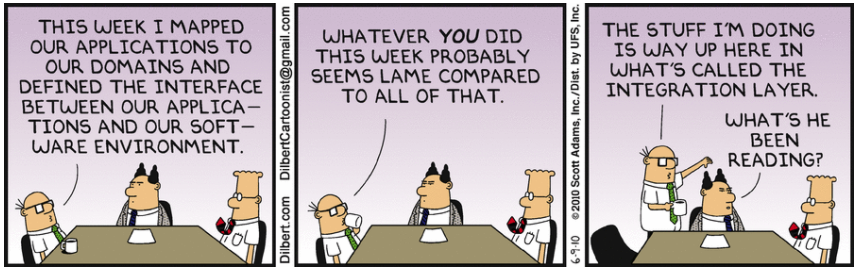
One of the dangers of a consultant looking at tech is that he can get lost in jargon. A few weeks ago, I did a little research on some of the most cutting-edge software startups in the cloud computing space (the idea that you can use a computer feature/service without actually knowing anything about what sort of technology infrastructure was used to provide you with that feature/service – i.e., Gmail and Yahoo Mail on the consumer side, services like Amazon Web Services and Microsoft Azure on the business side). As a result, I’ve looked at the product offerings from guys like Nimbula, Cloudera, Clustrix, Appistry, Elastra, and MaxiScale, to name a few. And, while I know enough about cloud computing to understand, at a high level, what these companies do, the use of unclear terminology sometimes makes it very difficult to pierce the “fog of marketing” and really get a good understanding of the various product strengths and weaknesses.
Is it any wonder that, at times, I feel like this Dilbert cartoon?:
Yes, its all about that “integration layer” …
My take? A great product should not need to hide behind jargon. Alas, if only more people listened…
At the start of the year, I made a list of four resolutions for 2010. Given my tendency to formally track things on an ongoing basis I thought I’d do a mid-year check-in on my resolutions seeing how roughly half the year has passed:
Not too bad if I can say so myself!
The past few weeks I’ve been eagerly watching a variety of Japanese television, and I noticed something very peculiar (for an American).
The few Japanese dramas I’ve seen actually end. They build to an end and then just stop. They don’t drag it out for season after season, allowing different seasons to suffer based on actor/actress-negotiations and writers having off-years. They don’t end on ridiculous season cliffhanger-after-season cliffhanger. They have a well-defined endpoint and, by building to it, they keep the story fresh and force it to have a suitable length.
This isn’t to say that the Japanese dramas I’ve seen don’t go on for multiple seasons. But, I would assert that sequels (should) only happen when there is sufficient audience demand for one and when the storytellers think they have another story to tell.
Contrast that with American TV – the seasons are built not for any plot reason, but because a TV studio needs to have sufficient content to fill the months of September to May/June. Seasons are renewed, not because of a deep creative reason or even necessarily because of audience demand, but because of a misguided sense of momentum. This doesn’t always turn into a disaster (I believe House MD, despite its traditional has maintained a reasonable level of quality each season through the quality of its casting and writing), but even series that I thoroughly enjoy like Smallville have had their fair share of “useless filler” episodes and bad seasons.
In my humble opinion, it’d be far better to adopt the miniseries format. It prevents writers from creating ridiculous plot devices to keep a story going way past its prime (and past when its actors begin leaving for greener pastures), and it maintains a quality of production which only a purpose-driven creative process can lead to.
Given the challenges of the TV business, I’d say its at least worth a shot for an American TV studio to try.
Unless you just discovered YouTube yesterday, you’ve probably seen countless videos of (and maybe even have tried?) the infamous Diet Coke + Mentos reaction… which brings us to the subject of this month’s (belated) paper that I will blog about.
An enterprising physics professor from Appalachian State University decided to have her sophomore physics class take a fairly rigorous look at what drives the Diet Coke + Mentos reaction and what factors might influence its strength and speed. They were not only able to publish their results in the American Journal of Physics, but the students were also given an opportunity to present their findings in a poster session (Professor Coffey reflected on the experience in a presentation she gave). In my humble opinion, this is science education at its finest: instead of having students re-hash boring experiments which they already know the results of, this allowed them to do fairly original research in a field which they probably had more interest in than in the typical science lab course.
So, what did they find?
The first thing they found is that it’s not an acid-base reaction. A lot of people, myself included, believe the diet coke + Mentos reaction is the same as the baking soda + vinegar “volcano” reactions that we all did as kids. Apparently, we were dead wrong, as the paper points out:
The pH of the diet Coke prior to the reaction was 3.0, and the pH of the diet Coke after the mint Mentos reaction was also 3.0. The lack of change in the pH supports the conclusion that the Mint Mentos–Diet Coke reaction is not an acid-base reaction. This conclusion is also supported by the ingredients in the Mentos, none of which are basic: sugar, glucose, syrup, hydrogenated coconut oil, gelatin, dextrin, natural flavor, corn starch, and gum arabic … An impressive acid-base reaction can be generated by adding baking soda to Diet Coke. The pH of the Diet Coke after the baking soda reaction was 6.1, indicating that much of the acid present in the Diet Coke was neutralized by the reaction.
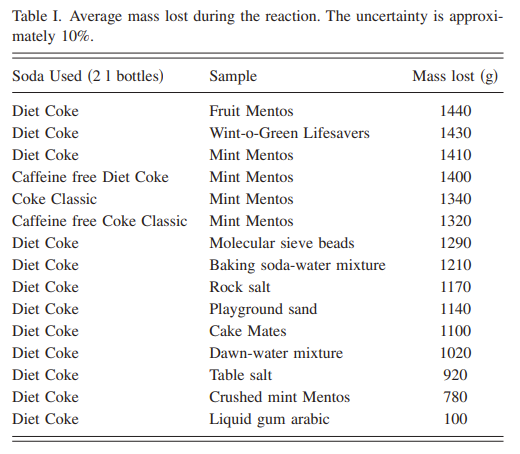
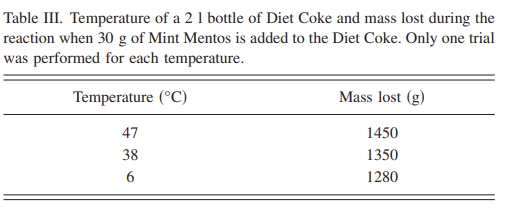
Secondly, the “reaction” is not chemical (no new compounds are created), but a physical response because the Mentos makes bubbles easier to form. The Mentos triggers bubble formation because the surface of the Mentos is itself extremely rough which allows bubbles to aggregate (like how adding string/popsicle stick to an oversaturated mixture of sugar and water is used to make rock candy). But that doesn’t explain why the Mentos + Diet Coke reaction works so well. The logic blew my mind but, in retrospect, is pretty simple. Certain liquids are more “bubbly” by nature – think soapy water vs. regular water. Why? Because the energy that’s needed to form a bubble is lower than the energy available from the environment (e.g., thermal energy). So, the question is, what makes a liquid more “bubbly”? One way is to heat the liquid (heating up Coke makes it more bubbly because heating the carbon dioxide inside the soda gives the gas more thermal energy to draw upon), which the students were able to confirm when they looked at how much mass was lost during a Mentos + Diet coke reaction under three different temperatures (Table 3 below):
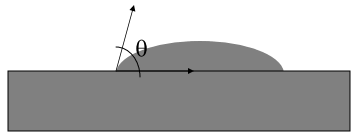
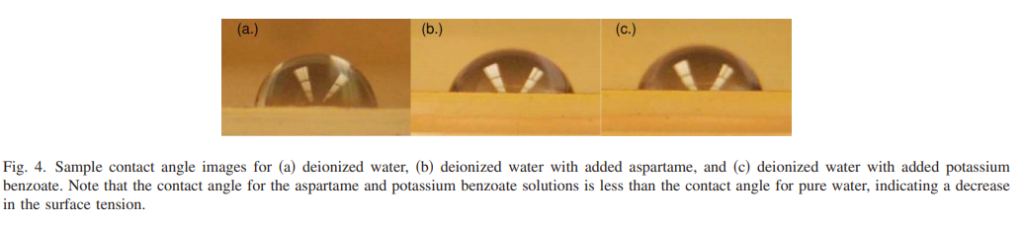
What else? It turns out that what other chemicals a liquid has dissolved is capable of changing the ease at which bubbles are made. Physicists/chemists will recognize this “ease” as surface tension (how tightly the surface of a liquid pulls on itself) which you can see visually as a change in the contact angle (the angle that the bubble forms against a flat surface, see below):
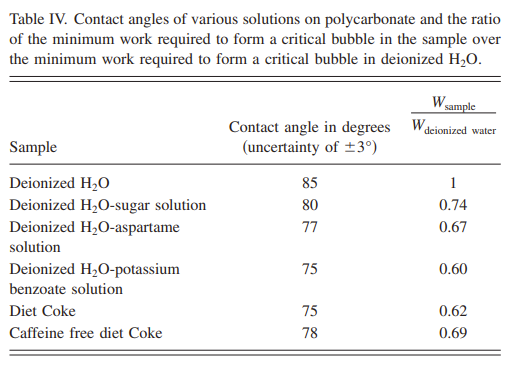
The larger the angle, the stronger the surface tension (the more tightly the liquid tries to pull in on itself to become a sphere). So, what happens when we add the artificial sweetener aspartame and potassium benzoate (both ingredients in Diet Coke) to water? As you can see in Figure 4 below, the contact angle in (b) [aspartame] and (c) [potassium benzoate] are smaller than (a) [pure water]. Translation: if you add aspartame and/or potassium benzoate to water, you reduce the amount of work that needs to be done by the solution to create a bubble. Table 4 below that shows the contact angles of a variety of solutions that the students tested as well as the amount of work needed to create a bubble relative to pure water:
This table also shows why you use Diet Coke rather than regular Coke (basically sugar-water) to do the Mentos thing – regular coke has a higher contact angle (and ~20% more energy needed to make a bubble).
Another factor which the paper considers is how long it takes the dropped Mentos to sink to the bottom. The faster a Mentos falls to the bottom, the longer the “average distance” that a bubble needs to travel to get to the surface. As bubbles themselves attract more bubbles, this means that the Mentos which fall to the bottom the fastest will have the strongest explosions. As the paper points out:
The speed with which the sample falls through the liquid is also a major factor. We used a video camera to measure the time it took for Mentos, rock salt, Wint-o-Green Lifesavers, and playground sand to fall through water from the top of the water line to the bottom of a clear 2 l bottle. The average times were 0.7 s for the Mentos, 1.0 s for the rock salt and the Lifesavers, and 1.5 s for the sand … If the growth of carbon dioxide bubbles on the sample takes place at the bottom of the bottle, then the bubbles formed will detach from the sample and rise up the bottle. The bubbles then act as growth sites, where the carbon dioxide still dissolved in the solution moves into the rising bubbles, causing even more liberation of carbon dioxide from the bottle. If the bubbles must travel farther through the liquid, the reaction will be more explosive.
So, in conclusion, what makes a Diet Coke + Mentos reaction stronger?
I wish I had done something like this when I was in college! The paper itself also goes into a lot of other things, like the use of an atomic force microscope and scanning electron microscopes to measure the “roughness” of the surface of the Mentos, so if you’re interested in additional things which can affect the strength of the reaction (or if you’re a science teacher interested in coming up with a cool project for your students), I’d strongly encourage taking a look at the paper!
Paper: Coffey, T. “Diet Coke and Mentos: What is really behind this physical reaction?”. American Journal of Physics 76:6 (Jun 2008) – doi: 10.1119/1.2888546

(Table 3, Figure 4, Table 5 from paper) (Contact angle description from presentation)
Happy fourth of July to all my American readers out there. Although this is coming a little late in the day, I hope your day was full of fireworks, barbeques, and reflecting on what makes the US such a great country to live in and be a part of.
For those of you who aren’t American, I’m sure you can find an event, birth, or death in Wikipedia to celebrate as well! Perhaps, the first publishing of Alice in Wonderland?