One of the most impressive developments in the web and the mobile phone space has been the emergence of new platforms for software developers to target. The developer’s repertoire is no longer just Windows, Mac OS, and Linux, but Android, iPhone OS, Windows Phone 7, Facebook, Twitter, and many more.
While these new platforms are big opportunities for developers, I always find it quite amusing to see the reaction of developers as they see the platform owners aggressively expand beyond their original domains, for example:
I’m always shocked at how up-in-arms developers can get about these moves. Why? Because this is nothing new in the software industry. Remember when Microsoft bundled Internet Explorer with their operating system and killed off Netscape? Or when Apple bundled iTunes into Mac OS and killed third-party MP3 player developers? Or IBM, widely considered a pioneer in open source, who bundles a full and very closed software stack with its UNIX servers and mainframes?
So, how does any developer succeed (seeing how most developers don’t control the platforms they develop for)? They key is to understand the economics from the platform owner’s vantage point:
Put them together, and you drive a number of conclusions about where platform owners will make aggressive inroads into the domains of their developers:
“Plumbing” – To a platform owner, the platform’s inner workings are sacred. After all, a platform’s performance and ability to work with content/applications is heavily tied to its “plumbing”. In the same way that you aren’t likely to trust a random stranger to do open heart surgery on you, platform owners are unlikely to trust third party hacks/modifications on their platform’s inner workings and are unhappy when third party developers clog their “pipes” with too many requests/garbage. It should be no surprise that platform owners often restrict access to and limit/prevent modifications to a platform’s inner workings. Similarly, because of the value of integrating enhancements to lower level processes into the platform itself, it is also likely that platform owners will make their own modifications when needed and heavily restrict access (if its granted at all) to those lower level processes. Examples: APIs which tap into hardware-level capabilities on operating systems, quantity limits on social network/web service API usage, device driver creation in operating systemsSo, what to do if you’re a developer who doesn’t own your own platform? The following is a quick (and by no means comprehensive) list
Ally yourself with other developers: I pointed out earlier that the reason a platform owner exists is to sell and improve the value of the platform. Because of this and because the value of a platform is dependent on having a vibrant developer community, platform developers are loath to make aggressive moves which may alienate that community. To that end, aligning oneself with other developers can help amplify one developer’s protest when a platform owner makes an aggressive move encroaching on your turf.It was great that there was a time when one could be a success just by building cute Twitter mobile applications that don’t do anything more than access Twitter’s basic API, but such a strategy was never going to be sustainable. And the same thing is (or will be) true for a lot of the other new platforms.
(Image credit – Apps) (Image credit – Fish) (Image credit – Pipes) (Image credit – Fish)
One reason I love science fiction is that it challenges our morals and beliefs in a way that other art forms rarely do. It asks us difficult questions, like, what if we had the ability to visit other planets and encounter different cultures? What if we could genetically “design” our children? What if we could go back in time and change history?
Unsettling questions aren’t they? But, why are they unsettling? My personal belief is that they are unsettling because our intuitions, our values, our beliefs, our laws, and our institutions were not designed to handle those questions. If you assume that Western culture is heavily derived from Ancient Greek and Roman humanism, is it any wonder that society has trouble understanding what to do with our nuclear arsenals or with humankind’s new ability to genetically alter the people and animals around us? After all, the foundations of today’s laws and values predated when people could even conceive that humans would ever have to think about such things.
So, when people ask me what I think about all the press that privacy concerns about Google or privacy concerns about Facebook or any of the other myriad social networks have garnered, I view it as manifestation of the fact that we now have technology which makes it super-easy to share information about ourselves and our location but we have yet to develop the intuititions, values, and laws/institutions to handle it.
Lets use myself as an example: I personally find auto-GPS-tagging my Tweets to be oversharing. However, I frequently Tweet the location I’m at and even the friends I’m with. Is this odd combination of preferences an example of irrationality? Probably (I was never the brightest kid). But I’d argue its more about my lack of intuition on the technology and the lack of clear cultural norms/values.
And I’m not the only one who is beginning to come to terms with the un-intuitiveness of our digital lives. My good friend, and prominent blogger, Serena Wu recently went through a social network consolidation/privacy overhaul as a result of understanding just what it was she was sharing and how it could be used. All across the internet, I believe users are beginning to understand the consequences to privacy of their social network and search engine behavior.
Now, the easy reflex thing to do would be to simply cut off such privacy issues and cut out these social networks like one would a tumor. But, I think that would be a dramatic over-reaction akin to how the Luddites reacted to factory automation. It ignores the potential value of the technology: in the case of sharing information on social networks, this can come in the form of helping people advertise themselves to employers, assisting friends with keeping in contact with one another, and/or even delivering more valuable services over the internet. Now, that shouldn’t be construed as a blanket defense of everything Facebook or Twitter or Google does, but an understanding that there is a tradeoff to be made between privacy and service value is necessary to help the services, their users, society, and the government realize the appropriate changes in intuition, values, and rules to properly cope.
I’m not smart enough to predict what that tradeoff will look like or how our intuitions and values may change in the future, but I do think we can count on a few things happening:
In the meantime, the few tips I listed below will probably be relevant to users regardless of how our rules, values, and intuitions change:
No matter what happens in the web service privacy area, we are definitely in for an interesting ride!
(Image credit – ethics) (Image credit – Big Facebook Brother)
Apologies for the lack of blogging – have been on a week-and-a-half-long vacation!
While visiting my college roommate Eric at Princeton last week, his fiancée Jen took me to an amazing local attraction: Grounds for Sculpture in Hamilton, NJ. “Sculpture garden” doesn’t do the park justice in terms of how beautiful the scenery is, how interesting some of the sculptures are, or how cool some of the three-dimensional recreations of classic paintings are.
And, as I did before in the de Young sculpture garden, I decided to, in between admiring the park and its resident sculptures, “have a good time” (thanks to Jen for her patience and willingness to indulge my silly side):
Here’s me trying to get sweet with a lady. Her male friend didn’t seem too happy to see me:
Here, I explain my life story to a very interested dinner party (see if you can recognize the painting!):
One of the lovely ladies in the above party didn’t believe a word I said, whereas the other wore a shockingly hideous dress:
Nearby, a very lovely woman invited me to watch her shower:
Here, I hang out with some of the locals – who for some reason, enjoyed hanging out on the grass, naked (see if you can recognize this painting!):
These next two pictures show how I learned to avoid touching big cats:
This is me, soaking in the glory of the universe:
Needing some cash (to pay for my flight home), I robbed a nice couple who were in the middle of an embrace…
Jen, being a very talented artist, was not impressed by one of the local painters:
And quickly spread rumors about the painter’s lack of talent:
A gentleman and I lectured a young woman about the dangers of associating with bad men:
I also met a guy who really seemed to get me:
I found out that sheep are really cool to hang out with:
I tried to learn how to dance from a local maiden (I don’t think I succeeded):
A local and I decided to watch some local women dance (Can you recognize this painting? And yes, the “guy” I’m lying next to is a sculpture):
Enchanted by the beautiful sculptures around me, I decided to pray to the Muses for artistic inspiration – I’ll tell you if I ever get any
:
As you can see, I had one helluva time and would definitely recommend a visit!
The power of connectivity:
So I get to help the partner out without breaking a sweat
.
My buddy Bill shared an article on Google Reader about the demise of Newsweek which linked to this New York Times article (does anyone else find it ironic that one newspaper experiencing financial problems is calling out another publication’s financial problems?):
American newsweeklies were built on original reporting of Large Events, helping readers make sense of a complicated world, but it is a costly endeavor with diminishing returns during an era of commodified and chewed-over news. Both The Economist and The Week were built, rather Web-like, to “borrow” the reporting and then spread analysis on top, thereby making a sundae without having to crank the ice cream maker.
And in this instance, the foreignness of the brands gives the reader an intellectual sheen that once Olympian domestic brands can’t. The Economist and The Week not only make you smarter at cocktail parties by giving you a brief on the week events, but name-checking them will make you sound in the know. Mention Newsweek and people will wonder whether you’ve been going to the dentist a lot lately.
Don’t you love British wit?
I’m an avid reader of The Economist, and Bill’s shared article got me thinking of why it is that I read The Economist (and many of the other things in my reading list) rather than the numerous other publications out there:
The interesting thing is, without even thinking about it, the list of news-y blogs/web feeds I follow (right-hand-side column of my Links page) has steadily fallen more in line with the 6 reasons I mentioned above. Of course, the list could always use some pruning/adjusting (and as anyone who’s seen how much I share over Google Reader or on Twitter, they can tell I have a lot that I could cut from my list), but I think this set of 6 criteria is as good as any for helping people to manage their information sources.
What other criteria do people use in finding good sources of information/news to follow?
(Image credit – cover 1) (Image credit – cover 2) (Image credit – cover 3)
I think I’m long overdue for an actually comics-y comic book post.
For years, Marvel comics readers have known of S.H.I.E.L.D, the American super-spy organization formerly run by Nick Fury (pictured on the left, he’s the cool-looking guy with the eye-patch, not the freaky green guy who is probably a minion of HYDRA).
As a big fan of the super-spy concept, the idea of SHIELD always had intuitive appeal to me, which is why I became very excited when I found out that superstar writer Jonathan Hickman was writing a new series called S.H.I.E.L.D which would dive into the history of the SHIELD organization and how it dates back to the time of Ancient Egypt as a secret society of polymaths who sought to protect the world.
In the first issue alone (cover pictured on the right), we have already seen such famous historical (and fictional) polymaths (translation: genius in multiple fields) as:
The idea of history’s greatest geniuses as superheroes in a historical secret society is an idea that this fanboy/nerd can’t help but love (not to mention the thrill from the incorporation of the Asian polymath Zhang Heng in a comic with a predominantly Western audience), and it got me thinking, who else would it be awesome to have on this team of super-luminaries? We already know that Nostradamus and Sir Isaac Newton will play heavily in the rest of the series, but who else? The comics blog the Weekly Crisis took a quick stab at it, but I thought I’d also make my own list
:
Of course, I’m not a writer – so who knows if any of these suggestions would actually make great stories (although I obviously think they will). Regardless, I’m very excited to read the coming issues of this series, and would recommend it to anyone else who has a taste for seeing major historical geniuses take on threats to the safety of the human race!
So, which other polymath/geniuses or major historical figures would you want in SHIELD?
Another month, another paper to read and blog about.
Most people know that viruses are notoriously tricky disease-causing pathogens to tackle. Unlike bacteria which are completely separate organisms, viruses are parasites which use a host cell’s own DNA-and-RNA-and-protein producing mechanisms to reproduce. As a result, most viruses are extremely small, as they need to find a way into a cell to hijack the cell’s machinery, and, in fact, are oftentimes too small for light microscopes to see as beams of light have wavelengths that are too large to resolve them.
However, just because most viruses are small, doesn’t mean all viruses are. In fact, giant Mimiviruses, Mamaviruses, and Marseillesviruses have been found which are larger than many bacteria. The Mimivirus (pictured below), for instance, was so large it was actually identified incorrectly as a bacteria at first glance!

Little concrete detail is known about these giant viruses, and there has been some debate about whether or not these viruses constitute a new “kingdom” of life (the way that bacteria and archaebacteria are), but one thing these megaviruses have in common is that they are all found within amoeba!
This month’s paper (HT: Anthony) looks into the genome of the Marseillesvirus to try to get a better understanding of the genetic origins of these giant viruses. The left-hand-side panel of picture below is an electron micrograph of an amoeba phagocytosing Marseillesvirus (amoeba, in the search for food, will engulf almost anything smaller than they are) and the right-hand-side panel shows the virus creating viral factories (“VF”, the very dark dots) within the amoeba’s cytoplasm. If you were to zoom in even further, you’d be able to see viral particles in different stages of viral assembly!

Ok, so we can see them. But just what makes them so big? What the heck is inside? Well, because you asked so nicely:
As you can see, there are a whole lot of proteins which you would only expect to see in a “full-fledged” cell, not a virus. This begs the question, why do these giant viruses have so many extra genes and proteins that you wouldn’t have expected?
To answer this, the researchers ran a genetic analysis on the Marseillesvirus’s DNA, trying to identify not only which proteins were encoded in the DNA but also where those protein-encoding genes seem to come from (by identifying which species has the most similar gene structure). A high-level overview of the results of the analysis is shown in the circular map below:

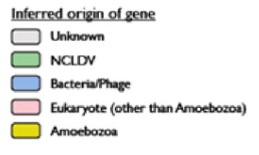
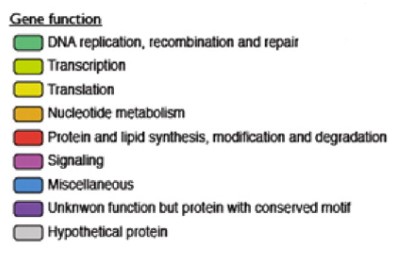
The outermost orange bands in the circle correspond to the proteins that were identified in the virus itself using mass spectrometry. The second row of red and blue bands represents protein-coding genes that are predicted to exist (but have yet to be detected in the virus; its possible they don’t make up the virus’s “body” and are only made while inside the amoeba, or even that they are not expressed at all). The gray ring with colored bands represents the researchers’ best guess as to what a predicted protein-coding gene codes for (based on seeing if the gene sequence is similar to other known proteins; the legend is below-right) whereas the colored bands just outside of the central pie chart represents a computer’s best determination of what species the gene seems to have come from (based on seeing if the gene sequence is similar to/the same as another specie’s; the legend is below-left).
Of the 188 genes that a computational database identified as matching a previously characterized gene (~40% of all the predicted protein-coding genes), at least 108 come from sources outside of the giant viruses “evolutionary family”. The sources of these “misplaced” genes include bacteria, bacteria-infecting viruses called bacteriophages, amoeba, and even other eukaryotes! In other words, these giant viruses were genetic chimeras, mixed with DNA from all sorts of creatures in a way that you’d normally only expect in a genetically modified organism.
As many viruses are known to be able to “borrow” DNA from their hosts and from other viruses (a process called horizontal gene transfer), the researchers concluded that, like the immigrant’s conception of the United States of America, amoebas are giant genetic melting pots where genetic “immigrants” like bacteria and viruses comingle and share DNA (pictured below). In the case of the ancestors to the giant viruses, this resulted in viruses which kept gaining more and more genetic material from their amoeboid hosts and the abundance of bacterial and virus parasites living within.

This finding is very interesting, as it suggests that amoeba may have played a crucial role in the early evolution of life. In the same way that a cultural “melting pot” like the US allows the combination of ideas from different cultures and walks of life, early amoeba “melting pots” may have helped kickstart evolutionary jumps by letting eukaryotes, bacteria, and viruses to co-exist and share DNA far more rapidly than “regular” natural selection could allow.
Of course, the flip side of this is that amoeba could also very well be allowing super-viruses and super-bacteria which could one day wipe out the human race to breed… but, maybe I’m just being paranoid.
Paper: Boyer, Mickael et al. “Giant Marseillevirus highlights the role of amoebae
as a melting pot in emergence of chimeric microorganisms.” PNAS 106, 21848-21853 (22 Dec 2009) – doi:10.1073/pnas.0911354106
(Image Credit – Mimivirus – Wikipedia) (Figures 1, 2, and 5 from paper)