Collateral damage by mitochondria

March 29th, 2010 · 6:00 am  →  Blog

Another month, another paper to read and blog about.

This month, I read a paper (HT: my ex-college roommate Eric) by a group from Beth Israel about systemic inflammatory response syndrome (SIRS) following serious injury. SIRS, which is more commonly understood/found as sepsis, happens when the entire body is on high “immune alert.” In the case of sepsis, this is usually due to an infection of some sort. While an immune response may be needed to control an internal infection, SIRS is dangerous because the immune system can cause a great deal of collateral damage, resulting in potentially organ failure and death.

Whereas an infection has a clear link to sepsis, the logic for why injury would cause a similar immune response was less clear. In fact, for years, the best hypothesis from the medical community was that injury would somehow cause the bacteria which naturally live in your gut to appear where they’re not supposed to be. But this explanation was not especially convincing, especially in light of injuries like burns which could still lead to SIRS but which didn’t seem to directly affect gut bacteria.image

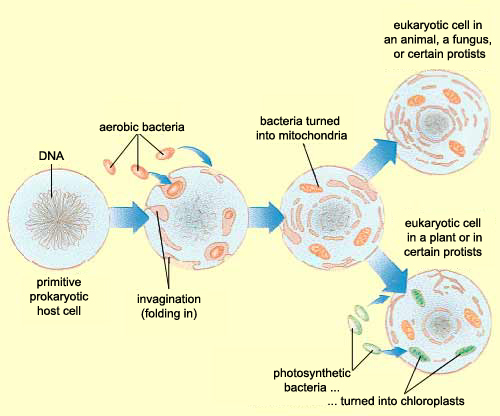
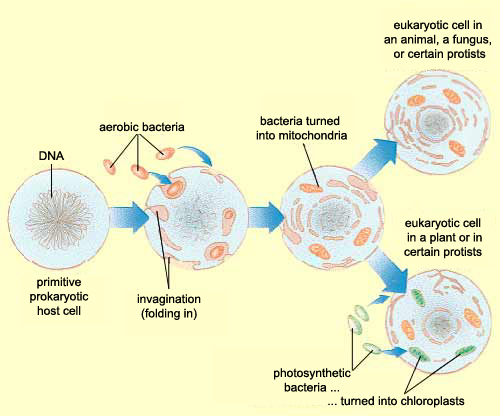
Zhang et al, instead of assuming that some type of  endogenous bacteria was being released following injury, came up with an interesting hypothesis: it’s not bacteria which is triggering SIRS, but mitochondria. A first year cell biology student will be able to tell you that mitochondria are the parts of eukaryotic cells (sophisticated cells with nuclei) which are responsible for keeping the cell supplied with energy. A long-standing theory in the life science community (pictured above) is that mitochondria, billions of years ago, were originally bacteria which other, larger bacteria swallowed whole. Over countless rounds of evolution, these smaller bacteria became symbiotic with their “neighbor” and eventually adapted to servicing the larger cell’s energy needs. Despite this evolution, mitochondria have not lost all of their (theorized) bacterial ancestry, and in fact still retain bacteria-like DNA and structures. Zhang et al’s guess was that serious injuries could expose a mitochondria’s hidden bacterial nature to the immune system, and cause the body to trigger SIRS as a response.

Interesting idea, but how do you prove it? The researchers were able to show that 15 major trauma patients with no open wounds or injuries to the gut had thousands of times more mitochondrial DNA  in their bloodstream than non-trauma victims. The researchers were then able to show that this mitochondrial DNA was capable of activating polymorphonuclear neutrophils, some of the body’s key “soldier” cells responsible for causing SIRS.
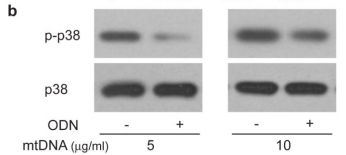
imageThe figure above shows the result of an experiments illustrating this effect looking at the levels of a protein called p38 MAPK which gets chemically modified into “p-p38” when neutrophils are activated. As you can see in the p-p38 row, adding more mitochondrial DNA (mtDNA, “-” columns) to a sample of neutrophils increases levels of p-p38 (bigger, darker splotch), but adding special DNA which blocks the neutrophil’s mtDNA “detectors” (ODN, “+” columns) seems to lower it again. Comparing this with the control p38 row right underneath shows that the increase in p-p38 is likely due to neutrophil activation from the cells detecting mitochondrial DNA, and not just because the sample had more neutrophils/more p38 (as the splotches in the second row are all roughly the same).

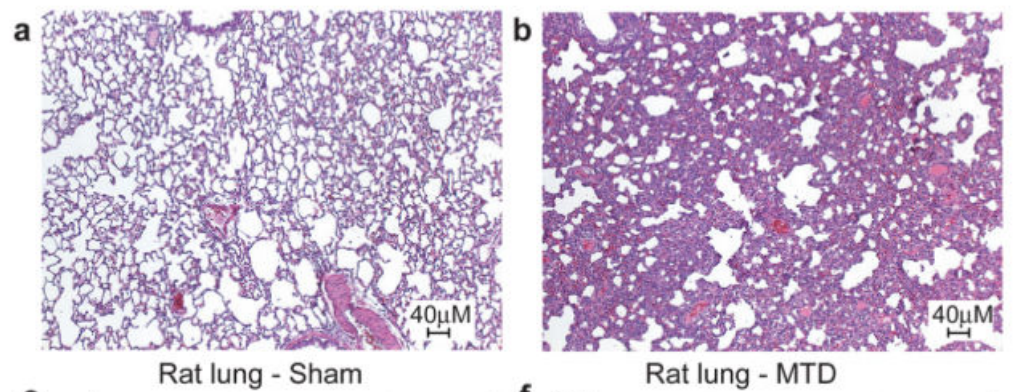
Cool, but does this mean that mitochondrial DNA actually causes a strong immune response outside of a test tube environment? To test this, the researchers injected mitochondrial DNA into rats and ran a full set of screens on them. While the paper showed numerous charts pointing out how the injected rats had strong immune response across multiple organs, the most striking are the pictures below which show a cross-section of a rat’s lungs comparing rats injected with a buffer solution (panel a, “Sham”) and rats injected with mitochondrial DNA (panel b, MTD). The cross-sections are stained with hematoxylin and eosin which highlight the presence of cells. The darker and “thicker” color on the right shows that there are many more cells in the lungs of rats injected with mitochondrial DNA – most likely from neutrophils and other “soldier cells” which have rushed in looking for bacteria to fight.
image

Amazing isn’t it? Not only did they provide part of the solution to the puzzle of injury-mediated SIRS (what they used to call “sterile SIRS”), but lent some support to the endosymbiont hypothesis!

Paper: Zhang, Qin et al. “Circulating Mitochondrial DAMPs Cause Inflammatory Responses to Injury.” Nature 464, 104-108 (4 March 2010) – doi:10.1038/nature08780


(Image credit) (Figure 3 and 4 from paper)

NFC for your tombstone?

March 25th, 2010 · 6:00 am  →  Blog

image Near-Field Communications (NFC) is a very interesting short range wireless standard which is behind a good deal of the smartcard and the cell-phone-as-credit-card/mobile payment technology out there. It promises to make it very easy to embed a ton of information into almost any object – whether it be your payment and identification information in a cell phone or tracking information on a box being shipped across the country – and to make it easily accessible to any device with an NFC chip merely by bringing the two NFC-bearing circuits together. This is an exciting area of development as it has the potential to change how we track products and storage, manage transactions, handle identity, and record information.

One direction I didn’t quite expect it to take, however, was on tombstones (HT: The Register). American NFC gizmo company Objecs has created a product called RosettaStone whereby the deceased can have detailed digital information about their lives stored in an NFC-accessible microchip embedded into your tombstone so that, they claim, 3200 years later, someone can use their NFC reader to find out more information about you.

image

Microchip + sticker + a leather case, all for $225. Come on, Marginal Revolutions, why hasn’t this made your Markets in Everything list yet?

(NFC N-mark – NFC Forum) (Image credit – Objecs)

Russia dreams of Silicon Valley sheep

March 22nd, 2010 · 6:00 am  →  Blog

image The Economist has an interesting article on the Kremlin’s latest push to modernize Russia’s economy and kick-start a wave of innovation which would supposedly lead to a “Russia with nuclear-powered spaceships and supercomputers.”

Far-fetched as this premise sounded, the article raised many thought-provoking questions on whether or not (and how) Russia could hope to build an innovation hub similar to the US’s Silicon Valley. One tidbit I found very interesting was that this isn’t the first time the Kremlin has tried something like this. Apparently, the Soviet Union, had attempted something similar in the past with very interesting political ramifications:

In the 1930s leading Soviet engineers arrested by Stalin laboured in special prison laboratories within the gulag. After the war, when Stalin required an atomic bomb, a special secret town was established where nuclear physicists lived in relative comfort, but still surrounded by barbed wire. Subsequently hundreds of secret construction bureaus, research institutes and scientific towns were set up across the Soviet Union to serve the military-industrial complex. They also spawned a technical intelligentsia. In the 1980s it was this class of educated people—permitted more freedom and better food than the rest of the country, but still poorly paid and not allowed to go abroad—that became the support base of perestroika [former Soviet Leader Mikhail Gorbachev’s attempt to liberalize/open up the Soviet Union which ultimately resulted in its collapse].

Russia’s rulers, however, seem keen on breaking this link between political openness/democracy and innovation:

Yet the experience of Mr. Gorbachev’s perestroika—which started with talk of technological renewal but ended in the collapse of the Soviet system—has persuaded the Kremlin to define modernisation strictly within technological boundaries. Hence Mr Medvedev’s warning not to rush political reforms. His supporters argue that only authoritarian government is capable of bringing the country into the 21st century. “Consolidated state power is the only instrument of modernisation in Russia. And, let me assure you, it is the only one possible,” said Vladislav Surkov [the Kremlin’s “chief ideologist” who put forth the current plan]

Is Surkov right about the lack of importance of democracy and political freedom? It’s hard to say for sure, but the success of the Asian tigers (esp. Korea, Taiwan, Singapore, and China) in this arena suggests that, at first glance, Surkov is right. Innovation and rapid economic growth do not require democracy so much as:

  1. effective and (relatively) un-corrupt governments
  2. free market systems which allow for consumer/business choice and property rights protection
  3. government investment in “innovation hubs” (e.g., Silicon Valley) where companies/universities/individuals readily share insights and collaborate

Of course, the flip side of the argument, is that its pretty rare for (1) and (2) to exist without democracy and at least basic political systems in place around due process and the respect for individual rights.

imageA successful attempt on (3) is difficult, regardless of the type of government authority (think of the countless failed attempts by cities, states, and countries to replicate Silicon Valley), but is especially difficult for “command regimes” in attempting to encourage innovation. It’s much simpler for an authoritarian government to find ways to double steel production (a la the Soviet Union’s Five-Year Plans) than it is for an authoritarian regime to encourage the trial & error, open exchange of ideas, and “disorganized” development which is necessary to drive innovative technology disruptions (which by definition can’t be “commanded”).

I’ve even heard it theorized that one reason the Soviet military elite allowed the perestroika which helped lead to its eventual collapse was their recognition that authoritarian regimes were not effective at encouraging the sort of innovation needed to build the computer technology which was giving (and still gives) the US its military advantage over the rest of the world.

But the harshest (and snarkiest) indictment of Russia’s short-sighted strategy here comes at the end of the Economist piece:

Mr Surkov is quite right when he argues that democracy would not stimulate technical innovation. The reason for this, however, is that under democracy a country with a declining population, a frighteningly high rate of birth defects, crumbling infrastructure and deteriorating schools might find a better use for taxpayers’ money than pouring it into Mr. Surkov’s Silicon Valley dreams.

Russia’s economy will likely grow quickly, regardless of the success of the Kremlin’s latest plans, by virtue of its resourceful population and economic convergence, but I suspect its future in terms of quality of life and innovation depends on whether it ever gets around to its much-needed political reforms.

(Image credit) (Image credit)

Keep your enemies closer

March 18th, 2010 · 6:00 am  →  Blog

One of the most interesting things about technology strategy is that the lines of competition between different businesses is always blurry. Don’t believe me? Ask yourself this, would anyone 10 years ago have predicted that:

I’m betting not too many people saw these coming. Well, a short while ago, the New York Times Tech Blog decided to chart some of this out, highlighting how the boundaries between some of the big tech giants out there (Google, Microsoft, Apple, and Yahoo) are blurring:

image

Its an oversimplification of the complexity and the economics of each of these business moves, but its still a very useful depiction of how tech companies wage war: they keep their enemies so close that they eventually imitate their business models.

(Chart credit)

A Case Fit for House MD Part 2

March 15th, 2010 · 6:00 am  →  Blog

A little over two years ago, I blogged on a very interesting New England Journal of Medicine paper about a bizarre medical case where a young female patient actually took on the blood type of a little boy who’s liver she had taken in a transplant. I had noted then that such an amazing (and not fully-understood) event definitely qualified for being a House MD moment, after one of my favorite TV shows about everyone’s favorite misanthropic genius doctor.

Two years later, a friend of mine from college shows me another case with a similar “signature”, making me dub this “A Case Fit for House MD Part 2”!

The setup (more details in Wikipedia): a 52-year-old woman named Karen Keegan was in need of a kidney transplant and, of course, tested her children for donor compatibility. What she discovered, completely rocked her world. To quote the Damn Interesting page I just linked to:

Imagine if you discovered one day that two of your three children were genetically not yours. Recriminations, marital troubles, perhaps a divorce, right? Now add a twist. What if you were these children’s mother? Suddenly the question becomes not “Who?” but rather “Huh?”

“Huh?” is right.

So, what’s the explanation for how a mother could possibly give birth to children who are genetically not matched to her? The current theory is chimerism.

imageThe type of  biological chimerism, named after the mythical chimera which had the parts of a lion, snake, and goat all in one (see image on the right), we usually see involves an organism having DNA from multiple species. This is usually something more mundane and research/medicine-oriented like creating mice that have genes which give them a human being’s immune system. These “humanized” mice are then used to produce human antibodies which can then be used for medicinal purposes.

A more dramatic example in nature would be the parasitic chimerism that the Ceratioid Anglerfish practices – where the males of the species actually fuse with females to become some sort of chimeric (and immediately fertile) hermaphrodite.

In humans, a common form of chimerism that is observed is in a small proportion of fraternal twins where, because of linkages between their blood supply and blood-producing organs,end up having “shared blood”. They each have and will continue to produce blood cells from their other twin, despite the rest of their body being genetically distinct.

But what about the curious case of our mother who’s kids don’t appear to be hers? What sort of chimerism explains this? A New England Journal of Medicine paper dives into the science, but basically, the theory is that Karen Keegan had a fraternal twin. But, rather than simply share blood cells/blood-producing cells, Keegan and her twin had actually fused in the womb. This theory was supported when they found two sets of DNA in her tissues (one set of which matched her un-matching children).

Interestingly, this paper was cited in the 2002 trial of a British woman named Lydia Fairchild who was denied custody of her children and welfare support because she could not prove with a genetic test that she was the mother of her children. The story was later put into a documentary called “I Am My Own Twin”.

So, anyone want to pitch using this to House MD?

(Edit: It’s been brought to my attention by… pretty much all of my friends who watch House that genetic chimerism was actually the diagnosis for the second episode of season 3 — I suppose I won’t be able to sell this screenplay to the writers after all…)

(Image credit)

This is how you make a resume

March 8th, 2010 · 6:00 am  →  Blog

The best recruiting advice I can give is to make your resume exactly like this fictional representation of what Sergey Brin (one of Google’s co-founders)’s resume looks like (HT: Pierre Lindenbaum):

image

Why do we like it?

  • It’s unnecessary, in a good way. Does anyone really need to read Sergey Brin’s resume to know he’s sharp? You are unlikely to be Sergey, but there are things you can do (doing informational interviews, networking, being recommended) which can help make your resume unnecessary in a good way
  • It’s simple. I can’t tell you how many resume’s I’ve read where the writer has tried to pack every last detail of his/her life into it. No. We don’t use resume’s to judge you as a human being – we use them to judge if you could be a good employee, worthwhile to interview.
  • Big font. Easy on the eyes. Memorable. To the point.

Rock on, Sergey Brins of the world.

(Image credit)

Cartoons tell the story of my life

March 4th, 2010 · 6:00 am  →  Blog

A recent Dilbert cartoon pokes fun at the struggle that I’m sure many people feel between breaking off and doing something on their own versus sticking with their current job:

image

When I sent this to a few of my startup friends, one of them replied with a set of very entertaining cartoons (from Startup Comix) highlighting some of the… “hazards” of being a coding startup guy – as in loss of common sense :-) .

The first is around applying software version control (or how teams of several programmers can work on the same project without overwriting other people’s contributions or losing track of what was done before) to real life:

image

The second is around how coders might co-opt rappers’ “cash-money”:

image

Oh, and be sure to put these in the if you get this, you are hardcore nerd category :-)

(Dilbert cartoon) (Startup Comix 1) (Startup Comix 2)

Slime takes a stroll

March 1st, 2010 · 6:00 am  →  Blog

It was the end of February yesterday – which means its time to read/blog about another paper!

The paper I read for this month brought up an interesting question I’ve always had but never really dug into: how do individual cells find things they can’t “see”? After all, there are lots of microbes out there who can’t always see where their next meal is coming from. How do they go about looking?

A group of scientists at Princeton University took a stab at the problem by studying the motion of individual slime mold amoeba (from the genus Dictyostelium) and published their findings in the (open access) journal PLoS ONE.

As one would imagine, if you have no idea where something is, your path to finding it will be somewhat random. What this paper sought to discover is what kind of random motion do amoeboid-like cells use? To those of you without the pleasure of training in biophysics or stochastic processes, that may sound like utter nonsense, but suffice to say physicists and mathematicians have created mathematically precise definitions for different kinds of “random motion”.

Now, if the idea of different kinds of randomness makes zero sense to you, then the following figure (from Figure 1 in the paper) might be able to help:

image

Panel A describes a “traditional” random walk, where each “step” that a random walker takes is completely random (unpredictable and independent of the motion before it). As you can see, the path doesn’t really cover a lot of ground. After all, if you were randomly moving in different directions, you’re just as likely to move to the left as you are to move to the right. The result of this chaos is that you’re likely not to move very far at all (but likely to search a small area very thoroughly). As a result, this sort of randomness is probably not very useful for an amoeba hunting for food, unless for some reason it is counting on food to magically rain down on its lazy butt.

Panel B and C describe two other kinds of randomness which are better suited to covering more ground. Although the motion described in panel B (the “Levy walk”) looks very different from the “random walk” in Panel A, it is actually very similar on a mathematical/physical level. In fact, the only difference between the “Levy walk” and the “random walk” is that, in a “normal” random walk, the size of each step is constant, whereas the size of each “step” in a “Levy walk” can be different and, sometimes, extremely long. This lets the path taken cover a whole lot more ground.

A different way of using randomness to cover a lot of ground is shown in Panel C where, instead of taking big steps, the random path actually takes on two different types of motion. In one mode, the steps are exactly like the random walk in Panel A, where the path doesn’t go very far, but “searches” a local area very thoroughly. In another mode, the path bolts in a straight line for a significant distance before settling back into a random walk. This alternation between the different modes defines the “two-state motion” and is another way for randomness to cover more ground than a random walk.

And what do amoeba use? Panel D gives a glimpse of it. Unlike the nice theoretical paths from Panels A-C rooted around random walks and different size steps or different modes of motion, the researchers found that slime mold amoeba like to zig-zag around a general direction which seems to change randomly over the course of ~10 min. Panel A of Figure 2 (shown below) gives a look at three such random paths taken over 10 hours.

image

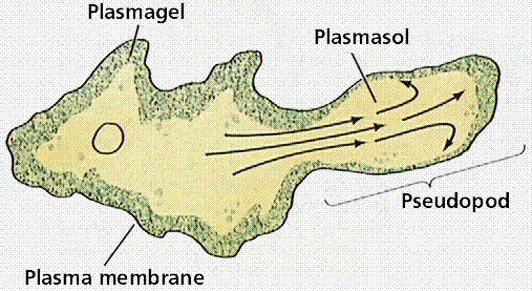
The reason for this zig-zagging, or at least the best hypothesis at the time of publication, is that, unlike theoretical particles, amoeba can’t just move in completely random directions with random “step” sizes. They move by “oozing” out pseudopods (picture below), and this physical reality of amoeba motion basically makes the type of motion the researchers discussed more likely and efficient for a cell trying to make its way through uncharted territory.

image

The majority of the paper actually covers a lot of the mathematical detail involved in understanding the precise nature of the randomness of amoeboid motion, and is, frankly, an overly-intimidating way to explain what I just described above. In all fairness, that extra detail is more useful and precise in terms of understanding how amoeba move and give a better sense of the underlying biochemistry and biophysics of why they move that way. But what I found most impressive was that the paper took a very basic and straightforward experiment (tracking the motion of single cells) and applied a rigorous mathematical and physical analysis of what they saw to understand the underlying properties.

The paper was from May 2008 and, according to the PLoS One website, there have been five papers which have cited it (which I have yet to read). But, I’d like to think that the next steps for the researchers involved would be to:

  1. See how much of this type of zig-zag motion applies to other cell types (i.e., white blood cells from our immune system), and why these differences might have emerged (different cell motion mechanisms? the need to have different types of random search strategies?)
  2. Better understand what controls how quickly these cells change direction (and understand if there are drugs that can be used to modulate how our white blood cells find/identify pathogens or how pathogens find food)

(All figures from paper) (Image of Pseudopod)

Paper: Li, Liang et al. “Persistent Cell Motion in the Absence of External Signals: a Search Strategy for Eukaryotic Cells.” PLoS ONE 3 (5): e2093 (May 2008) – doi:10.1371/journal.pone.0002093