
As I did with 2008 and 2007, a couple of highlights from this blog for the past year:
Happy new year, everybody!
(Image credit)
Pssst. I have a secret. The new Sherlock Holmes movie starring Robert Downey Jr., Jude Law, Rachel McAdams, and Mark Strong is good.
I am actually posting on that right at this moment because of the skeptical looks I’ve gotten after telling people that. Now, my tastes might not necessarily be the same as yours, and the trailer leaves something to be desired, but if you enjoy:
You’ll enjoy this film. And even if you don’t, you should still give it a chance.
The enemy of any manufacturing guru is variability. The obvious reason for this is that customers expect manufactured products to do what they’re marketed to do. But, there are also less apparent reasons around efficiency. For example, if step 1 of a manufacturing process introduces variability so that it actually ends up spitting out 3 outputs, then the success rate and complexity of subsequent steps will suffer. This also means the manufacturer will need to be able to deal with more delays and more testing and verification steps and even more customer support to handle products which don’t perform as they were marketed. Is it any wonder that statistical process control techniques like Six Sigma are so prevalent in the manufacturing sector?
But, while variability may be the enemy of the manufacturer, its become the ally of an innovative Silicon Valley-based startup called Verayo (HT: VentureBeat)
Verayo uses the fact that variability can never truly be eliminated from semiconductor manufacturing to create a “fingerprint” that can uniquely identify any manufactured chip. Those semiconductor process and/or cryptography guru’s can read more of the detail in a paper that MIT professor Srini Devadas wrote in 2002. But the concept is pretty simple. Verayo has created a technology they call PUF (Physically Unclonable Functions). PUFs are implemented as small modifications to a chip’s design which use the unique defects/quirks on each chip to produce a response to specific electronic “challenges.” Because no two chips have the same manufacturing “defects”, no two chips will have the same PUF responses to all possible challenges. This means the PUF effectively becomes a way to verify the identity of a given part which cannot be copied or duplicated!
This type of technology has countless applications. Verayo is particularly focused is in the area of RFID (radio frequency identification) tags which are used to identify charge cards, transit cards, identification papers, and many sold products. Verayo’s hope is to use their PUF technology to create unique RFID tags which cannot be copied or cloned to help identify counterfeit products (which will have a counterfeit, and hence incorrect, PUF challenge response) or establish an individual’s identity (imitations of PUFs will, like counterfeit product PUFs, have an incorrect PUF challenge responses). The Verayo concept diagrams are below
It doesn’t solve all problems (as there are still definite vulnerabilities at the manufacturer/identity issuer site), but it’s a promising way to turn one company’s problems into another company’s innovation.
(Image credit – Verayo)(Image credit – anticounterfeit)(Image credit – identity)
As a tech nerd who currently owns a Blackberry, I’m usually primarily focused on smartphones (like the iPhone and Android phones). However, Samsung’s Blue Earth caught my eye as an example of an innovative and very green design. Notice anything different about the back?
If you said, “those look like solar panels”, you’d be right. Samsung’s Blue Earth is impressively eco-friendly:
The phone boasts a feature set of what you would expect from a typical mid-range phone (touchscreen, 3.2 megapixel camera, WiFi, etc), and CNET’s reviewers were pleasantly impressed with it. The price tag is very heavy, though ($447), but I think its very cool that a market for such devices exists and I hope to see more products released along this particular dimension.
More details from the embedded CNET video review below:
So I finally took the plunge.
Instead of hosting my blog on Blogger, I’ve decided to move it over to a self-hosted WordPress blog which not only gives me a whole lot more control over content and styling (and has vastly more versatile plugins and themes), but allows me to start consolidating my online presence into, hopefully, a coherent presence. [This will also hopefully finally get Serena and Teresa to stop with their “Wordpress is so much better than Blogger” comments everytime they talk to me about my blog
]
The process, while complicated, was not as painful as I expected:
1. Design – With the help of my lovely girlfriend, I picked out the Berita theme from BizzArctic. It presents a very cool landing page with a slider and a sophisticated menu-ing system across the top. I then did some simple copy & paste to create a CV page (from an existing resume) and an About page (borrowed heavily from my LinkedIn profile). A quick scan of my Google Reader and some of my friend’s blogs helped me fill out the Links page, and a quick scan of my hard drive put together the various pieces of my Portfolio.
2. LifeStream – Through WordPress’s plugin directory, I found LifeStream which makes it easy to embed a LifeStream page and sidebar widget which aggregates my activities on Google Reader, Twitter, and my blogging life in one place.
3. Import – WordPress comes with a powerful import tool which made the actual moving of posts from Blogger to WordPress painless. Handling the URL’s (steps below) proved to be a bit more challenging…
4. Maintaining permalinks – Oddly, I discovered that WordPress and Blogger use a completely different mechanism for defining their permalink URLs (the web address that lets you visit the page for an individual post). Thankfully, Justinsomnia maintains a very helpful plugin which helps convert the much more rational WordPress permalink naming system into the peculiar Blogger URL naming system (and because WordPress’s plugins are basically combinations of PHP and Javascript/CSS, it turns out that it’s just a simple regular expression!)
5. Setting up a URL re-direct on Blogger – This too, thankfully, was very simple (just follow the steps after “Update your Blogger settings” as it sets up the Blogger URL re-direct – the playing around with the DNS is needed for it to be completely seamless, but I don’t think its necessary) and step #4 above makes it so that the URL re-directs from Blogger go to the correct WordPress page.
6. Correcting internal links – While steps #4 and #5 fix most of the URL issues, I wanted to fix the internal links so that people who read my blog wouldn’t have to deal with the ugly Blogger re-directs everytime they clicked on the many internal links I have in my blog. Thankfully, because WordPress relies on a SQL database to store all of the post content, a simple SQL command in phpMyAdmin was all that was needed to fix all the internal links.
7. RSS feed – Because most of the regular traffic I get on the blog comes through RSS readers, I wanted to make the transition seamless. Thankfully, I’ve been using Feedburner for quite some time so all I needed to do was switch out the source feed, and then I used the FeedSmith plugin to re-assign my blog’s RSS feed <META> tags to point to my Feedburner feed so that new subscribers would get the right one. So, most of you RSS readers won’t see any difference unless you actually click over to the page itself.
And voila! While I’m sure there are still a few kinks to work out (i.e. alas I’ve lost all the old Disqus comments from my Blogger days and the pictures on my blog are subject to the whims of Picasa/Google hosting), the new blog has been set up. So, please, check it out, let me know what you think, and for those of you with your own blogrolls or who haven’t yet figured out how to use RSS, please update your bookmarks & links!
Regardless of how you feel about Microsoft’s products, you have to appreciate the brilliance of their strategic “playbook”:
While the quality of Microsoft’s execution of each step can be called into question, I’d be hard pressed to find a better approach then this one, and I’m sure much of their success can be attributed to finding good ways to repeatedly follow this formula.

It’s for that reason that I’m completely bewildered by Microsoft’s consumer electronics business strategy. Instead of finding good ways to integrate the Zune, XBox, and Windows Mobile franchises together or with the Microsoft operating system “mothership” the way Microsoft did by integrating its enterprise software with Office or Internet Explorer with Windows, these three businesses largely stand apart from Microsoft’s home field (PC software) and even from each other.
This is problematic for two big reasons. First, because non-PC devices are outside of Microsoft’s usual playground, it’s not a surprise that Microsoft finds it difficult to expand into new territory. For Microsoft to succeed here, it needs to pull out all the stops and it’s shocking to me that a company with a stake in the ground in four key device areas (PCs, mobile phones, game consoles, and portable media players) would choose not to use one of the few advantages it has over its competitors.
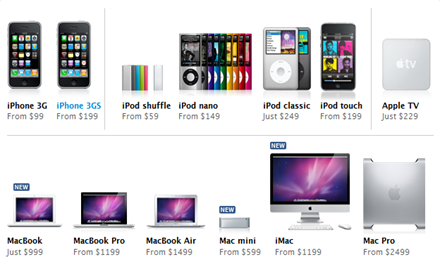
The second and most obvious (to consumers at least) is that Apple has not made this mistake. Apple’s iPhone and iPod Touch product lines are clear evolutions of their popular iPod MP3 players which integrate well with Apple’s iTunes computer software and iTunes online store. The entire Apple line-up, although each product is a unique entity, has a similar look and feel. The Safari browser that powers the Apple computer internet experience is, basically, the same that powers the iPhone and iPod Touch. Similarly, the same online store and software (iTunes) which lets iPods load themselves with music lets iPod Touches/iPhones load themselves with applications.
![]()
That neat little integrated package not only makes it easier for Apple consumers to use a product, but the coherent experience across the different devices gives customers even more of a reason to use and/or buy other Apple products.
Contrast that approach with Microsoft’s. Not only are the user interfaces and product designs for the Zune, XBox, and Windows Mobile completely different from one another, they don’t play well together at all. Applications that run on one device (be it the Zune HD, on a Windows PC, on an XBox, or on Windows Mobile) are unlikely to be able to run on any other. While one might be able to forgive this if it was just PC applications which had trouble being “ported” to Microsoft’s other devices (after all, apps that run on an Apple computer don’t work on the iPhone and vice versa), the devices that one would expect this to work well with (i.e. the Zune HD and the XBox because they’re both billed as gaming platforms, or the Zune HD and Windows Mobile because they’re both portable products) don’t. Their application development process doesn’t line up well. And, as far as I’m aware, the devices have completely separate application and content stores!
While recreating the Windows PC experience on three other devices is definitely overkill, I think, were I in Ballmer’s shoes, I would recommend a few simple recommendations which I think would dramatically benefit all of Microsoft’s product lines (and I promise they aren’t the standard Apple/Linux fanboy’s “build something prettier” or “go open source”):
(Image credit – Ballmer) (Image credit – Zune HD) (Image credit – Apple store)
When people think about strategy, they’re oftentimes looking for that one “silver bullet” which is the 100% correct and best answer. This is despite the fact that it is sometimes 100% valid to use random chance to make a decision.
Well, it turns out that bacteria have figured this out as well, as researchers have recently reported in Nature (HT: Wired Science). The researchers did a fascinating experiment where they forced bacteria to cope with a rapidly changing environment. Normally, you would expect that, if bacteria were forced into a different environment, the population as a whole would “evolve” to acquire the traits that are necessary to survive in that environment. And, at first, this is what the researchers observed – the shifts in environment “drove the successive evolution of novel phenotypes by mutation and selection.”
But, after a while, something very interesting happened – some of the bacterial populations (roughly 1 in 12) “recognized” that they were being put through the ringer and evolved a “gambling” strategy (the researchers called it a “stochastic switching between phenotypic states”) whereby individual bacteria would actually pick a strategy at random! “Knowing” that they were in a constant state of environmental flux with little predictability, these populations of bacteria evolved an ability to have individual bacterium pick random strategies such that genetically identical bacterium would end up with very different traits!
Many people, let alone bacteria, find the idea of a random strategy as a winning one to be counter-intuitive. But, the ability of even the simplest creatures to re-capitulate proves that randomness can not only be effective, but its possibly how the earliest living things coped with a very strange and rapidly changing environment.