
Graying

September 29th, 2009 · 7:00 am  →  Blog

Businesses need to see the trends that will affect their performance, whether they be technical trends, business model trends, or economic trends. One trend which I haven’t seen as many companies factor in (although you see many governments talking about it) is age demographics.

Completely ignoring my last post on the dangers of being obsessed with graphs, here is a very cool graph on how US population demographics will evolve over time as taken from the Calculated Risk blog (HT: Jeff L). In particular, I find the “Baby Boom” bulge (the wave of youngsters that came of age beginning from 1950-1970) moving towards the right to be very illuminating:

population

It highlights a trend which Japan is only beginning to grapple with – the “graying” of the American population that comes with the Baby Boomers becoming older. If Japan is any indication, that means the US will see a few things:

  • Rise in pension/Social Security costs and payments for care for the elderly
  • Decline in average wages as fewer lower-paid and younger workers replace more retiring higher-paid workers
  • Socio-economic changes that come from a smaller working-class population which needs to support a larger elderly population
  • Change in the political system as a balance will be sought between a growing importance in the elderly vote and the need for governments/companies to change the pension/healthcare payment balance and the ability of medical science to extend the workable years for elderly individuals
  • Change in business world as the elderly become more tech-savvy and become a more significant piece of the consumer population

If I were a business-owner looking at the long-term, I’d be looking long and hard at this list, and making investments into understanding how to convert these broad social/economic/political trends into insights which I can use to create a competitive advantage. For instance, if I were working in corporate strategy at Facebook, I’d be thinking of:

  • ways to make the site more attractive for the new generation of tech-savvy elderly
  • how to make my social network asset more valuable for elderly users (e.g. ways to make it easier to connect with old friends or family, ways to create mentoring relationships between older, more experience users and younger, less experienced ones, etc)
  • how to get useful ads that the elderly are more likely to pay attention to

Any other ideas on how things will change because of the demographic shift, and how businesses might adapt to them?

(Image credit)

Consultant syndrome

September 24th, 2009 · 7:00 am  →  Blog

It could happen to you too (HT: Megan McArdle).

Symptoms include excessive desire to represent every decision and factoid in life in simple chart form, especially in PowerPoint slide form. Treatment: long vacation with deep exposure to how people actually talk and relate to other humans.

Innovator’s Delight

September 22nd, 2009 · 7:00 am  →  Blog

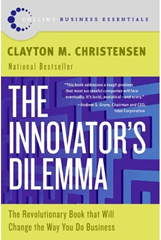
imageKnowing my interest in tech strategy, a coworker recommended I pick up HBS professor Clayton Christensen’s “classic” book on disruptive innovation: The Innovator’s Dilemma. And, I have to say I was very impressed.

The book tries to answer a very interesting question: why do otherwise successful companies sometimes fail to keep up on innovation? Christensen’s answer is counter-intuitive but deep: the very factors that make a company successful, like listening to customer needs, make it difficult for successful companies to adopt disruptive innovations which create new markets and new capabilities.

This sounds completely irrational, and I was skeptical when I first heard it, but Christensen makes a very compelling case for it. He begins the book by considering the hard disk drive (HDD) industry. The reason for this is, as Christensen puts it (and this is merely page one of chapter one!):

“Those who study genetics avoid studying humans, because new generations come along only every thirty years or so, and so it takes a long time to understand the cause and effect of any changes. Instead, they study fruit flies, because fruit flies are conceived, born, mature, and die all within a single day. If you want to understand why something happens in business, study the disk drive industry. Those companies are the closest things to fruit flies that the business world will ever see.”

image From that oddly compelling start, Christensen applies multiple techniques to establish the grounds for his theory. He begins by admitting that his initial hypothesis for why some HDD companies successfully innovated had nothing to do with his current explanation and was something he called “the technology mudslide”: that because technology is constantly evolving and shifting (like a mudslide), companies which could not keep moving to stay afloat (i.e. by innovating) would slip and fall.

But, when he investigated the different types of technological innovations which hit the HDD industry, he found that the large companies were actually constantly innovating, developing new techniques and technologies to improve their products. Contrary to the opinion of many in the startup community, big companies did not lack innovative agility – in fact, they were the leaders in developing and acquiring the successful technologies which allowed them to make better and better products.
But, every now and then, when the basis of competition changed, like the shift to a smaller hard disk size to accommodate a new product category like minicomputers versus mainframes or laptops versus desktops, the big companies faltered.

From that profound yet seemingly innocuous observation grew a series of studies across a number of industries (the book covers industries ranging from hardcore technology like hard disk drives and computers to industries that you normally wouldn’t associate with rapid technological innovation like mechanical excavators, off-road motorbikes, and even discount retailing) which helped Christensen come to a basic logical story involving six distinct steps:

  1. Three things dictate a company’s strategy: resources, processes, and values. Any strategy that a company wishes to embark on will fail if the company doesn’t have the necessary resources (e.g. factories, talent, etc.), processes (e.g. organizational structure, manufacturing process, etc.), and values (e.g. how a company decides between different choices). It doesn’t matter if you have two of the three.
  2. Large, successful companies value listening to their customers. Successful companies became successful because they were able to create and market products that customers were willing to pay for. Companies that didn’t do this wouldn’t survive, and resources and processes which didn’t “get with the program” were either downsized or re-oriented.
  3. Successful companies help create ecosystems which are responsive to customer needs. Successful companies need to have ways of supporting their customers. This means they need to have or build channels (e.g. through a store, or online), services (e.g. repair, installation), standards (e.g. how products are qualified and work with one another), and partners (e.g. suppliers, ecosystem partners) which are all dedicated towards the same goal. If this weren’t true, the companies would all either fail or be replaced by companies which could “get with the program.”
  4. Large, successful companies value big opportunities. If you’re a $10 million company, you only need to generate an extra $1 million in sales to grow 10%. If you’re a $10 billion company, you need to find an extra $1 billion in sales to grow an equivalent amount. Is it any wonder, then, that large companies will look to large opportunities? After all, if companies started throwing significant resources or management effort on small opportunities, the company would quickly be passed up by its competitors.
  5. Successful companies don’t have the values or processes to push innovations aimed at unproven markets, which serve new customers and needs. Because successful companies value big opportunities which meet the needs of their customers and are embedded in ecosystems which help them do that, they will mobilize their resources and processes in the best way possible to fulfill and market those needs. And, in fact, that is what Christensen saw – in almost every market he studied, when the customers of successful companies needed a new feature or level of quality, successful companies were almost always successful at either leading or acquiring the innovation necessary to do that. But, when it came to experimental products offering slimmer profit margins and targeting new customers with new needs and new ecosystems in unproven markets, successful companies often failed, even if management made those new markets a priority, because those companies lacked the values and/or processes needed. After all, if you were working in IBM’s Mainframe division, why would you chase the lower-performance, lower-profit minicomputer industry and its unfamiliar set of customers and needs and distribution channels?
  6. Disruptive innovations tend to start as inferior products, but, over time improve and eventually displace older technologies. Using the previous example, while IBM’s mainframe division found it undesirable to enter the minicomputer market, the minicomputer players were very eager to “go North” and capture the higher performance and profitability that the mainframe players enjoyed. The result? Because of the values of the mainframe players as compared with the values of the minicomputer players, minicomputer companies focused on improving their technology to both service their customer’s needs and capture the mainframe business, resulting in one disruptive innovation replacing an older one.

image The most interesting thing that Christensen pointed out was that, in many cases, established companies actually beat new players to a disruptive innovation (as happened several times in the HDD and mechanical excavator industries)! But, because these companies lacked the necessary values, processes, and ecosystem, they were unable to successfully market them. Their success actually doomed them to failure!

But Christensen doesn’t stop with this multi-faceted and thorough look at why successful companies fail at disruptive innovation. He spends a sizable portion of the book explaining how companies can fight the “trappings” of success (i.e. by creating semi-independent organizations that can chase new markets and be excited about smaller opportunities), and even closes the book with an interesting “ahead-of-his-time” look (remember, this book was written over a decade ago!) at how to bring about electric cars.

I highly recommend this book to anyone interested in the technology industry or even, more broadly speaking, on understanding how to think about corporate strategy. While most business books on this subject use high-flying generalizations and poorly evaluated case studies, Christensen approaches each problem with a level of rigor and thoroughness that you rarely see in corporate boardrooms. His structured approach to explaining how disruptive innovations work, who tends to succeed at them, why, and how to conquer/adapt to them makes for a fascinating read, and, in my humble opinion, is a great example of how corporate strategy should be done – by combining well-researched data and structured thinking. To top it all, I can think of no higher praise than to say that this book, despite being written over a decade ago, has many parallels to strategic issues that companies face today (i.e. what will determine if cloud computing on netbooks can replace the traditional PC model? Will cleantech successfully replace coal and oil?), and has a number of deep insights into how venture capital firms and startups can succeed, as well as some insights into how to create organizations which can be innovative on more than just one level.

Book: The Innovator’s Dilemma by Clayton Christensen

(Image credit: hard disk drive) (Image credit: David and Goliath)

Why Comics? Why SciFi?

September 17th, 2009 · 7:00 am  →  Blog

There’s no denying it. Comic books and science fiction have more than their fair share of “only for geeks.” While I would be hard pressed to deny who I am, I will say that my love for science fiction goes far beyond just pure escapism.

imageNow, I could talk about how I think comic books represent a reassuring world where the good guys triumph and where the human spirit and concepts of justice and loyalty are all that is necessary to be a hero, and how I believe that science fiction represents an optimism about the future and the importance of human emotions and morals. But instead of “taking my word for it”, why not hear Reading Rainbow host and the actor behind Star Trek’s Geordi LaForge LeVar Burton take on the subject (yes, the quotes were an intentional Reading Rainbow reference):

I’m one of those people that believes that there was some kid back in the 1960s watching Star Trek, and he kept seeing Captain Kirk pull out this communicator and flip it open – and that kid grew up and became an engineer, a designer of products, and we now have a device that is more common than the toaster. How many flip phones do you see on a daily basis? That which we imagine is what we tend to manifest in third dimension –  that’s what human beings do, we are manifesting machines.  The metaphor of a man who has an external electronic device, something man-made that serves him and somehow serves humanity, and that he becomes so aligned with that device, with the power of that device, that at one point he can discard it – I think that’s a real metaphor for the human journey. One day we won’t need a transporter device to get from one place to another.  And it begins with the wheel and then migrates through airplanes to some future technology that we can’t produce yet but we can imagine.  Imagination is really the key part of the human journey, it’s the key to the process of manifesting what our heart’s desire is.

When I was a kid, it was comic books that pointed me in that direction and from comic books I went to science fiction literature, which is still one of my most favorite genres of literature to read.  Don’t underestimate the power of comics and what they represent for us and how they inform us on the journey of being human – because it’s powerful. It’s very powerful. They give us permission to contemplate what’s possible. And in this world, in this universe, there’s nothing that is not possible.  If you can dream it, you can do it.

To many African-Americans, like Burton and fellow Star Trek actor/fan Whoopi Golderg, Star Trek holds a very special role in their minds:

imageWhen I was a kid, I read a lot of science fiction books and it was rare for me to see heroes of color in the pages of those novels.  Gene Roddenberry had a vision of the future, and Star Trek was one that said to me, as a kid growing up in Sacramento, California, “When the future comes, there’s a place for you.”  I’ve said this many times, and Whoopi (Goldberg) feels the same way – seeing Nichelle Nichols on the bridge of the Enterprise meant that we are a part of the future.  So I was a huge fan of the original series and to have grown up and become of that mythos, a part of that family, and to represent people dealing with physical challenges, much like what Nichelle Nichols represented for people like Whoopi and myself, I can’t even begin to share with you what that means to me.

While I was fortunate enough to be born in an era where nobody questions the role of Asian-Americans in industry and science, I can also see why many Asian-Americans would have been similarly inspired by George Takei’s role as Sulu in the original Star Trek series.

(Interview on LeVar Burton’s upcoming role in DC’s Superman/Batman: Public Enemies DVD) (Image Credit – LeVar Burton) (Image Credit – Nichelle Nichols)

More thoughts on the healthcare debate

September 15th, 2009 · 7:00 am  →  Blog

If you follow this blog at all, you’ll know that healthcare policy is a big interest of mine. Given that this was the focus of President Obama’s most recent address (and that this blog is my personal soapbox) I thought I’d chip in three thoughts to the blogosphere “marketplace of ideas” on the topic.

image The first is that I’ve been very impressed with President Obama’s efforts. This may come as a shock to my more liberal friends who have been reading my Google Reader shares on the subject, many of which have been critical of Obama’s plans. But, as someone who was not terribly impressed with Hillary Clinton’s efforts in healthcare in the 1990s, I have been pleasantly surprised by the different strategy that Obama has taken. At least from this blogger’s perspective, Obama’s process has been much more open, allowing the plan to receive input and win support from the numerous groups which need to be won over (i.e. pharmaceutical companies, doctors and nurses, insurance companies, hospitals, etc), and much more driven by Congress rather than force-fed from the Executive Branch.

The result? In my opinion, a much more nuanced policy than what I’m used to hearing from pie-in-the-sky single-payer advocates and market fundamentalists with a promising focus on addressing access and cost concerns with a combination of regulatory/government directives and market-based methods.

image

The second is around the balance between using government initiatives and using private markets to solve the US’s healthcare problems. I tend to be biased towards the latter, given my lack of faith in the ability of central organizations to solve the coordination, innovation, pricing, and customization challenges which markets are more adept at solving. With that said, anyone who is not a free-market fundamentalist is probably also aware of the coordination challenges that markets face (i.e. one of the reasons why we don’t trust the market to be entirely responsible for national defense or international treaties) and the blindness to equality/access concerns that markets can have.

From that perspective, I think the Obama plan does a relatively good job of balancing the two. After all, I can list at least two “market failures” that are abound in the American healthcare system:

  1. One can probably assign blame for many of our current complaints about American healthcare to the fact that there is a very poor market for health insurance (David Leonhardt at the NYTimes does). After all, why would insurance providers increase quality while lowering cost when most US healthcare coverage decisions are made by employers who don’t have the incentive or the information to shop around between plans and the fact that, in many markets, there are very few insurance companies who a consumer can choose between.
  2. Holding concerns of access aside, not enough people get health insurance. This is true for three reasons. First, people oftentimes underestimate the “safety net” that they may actually need to deal with sudden illnesses and accidents. Without the bargaining power of a large health insurance company on your side, the costs of seeing a doctor and obtaining treatment are astronomical – something which many uninsured find out when they suddenly need treatment. Second, the fact that the uninsured are able to still get government-funded care or emergency room care, while morally praiseworthy, means that extra costs are added to our healthcare system (and hence our insurance premiums and copays) which could be avoided had those individuals originally been covered. Finally, there are a number of conditions (e.g. breast cancer) which are more easily and cheaply dealt with if detected and treated earlier. Individuals without health insurance oftentimes are less likely to find and treat these conditions early on, resulting in greater costs and more difficult problems for doctors to treat.

That Obama is pushing for a regulated “insurance exchange” and a requirement that all individuals have health coverage is, to me, a step in the right direction to addressing these two issues. The devil is of course in the details, but the fact that Obama is leaning towards these provisions is very encouraging.

imageI am much less enthusiastic about the “public option” that has been thrown around because I don’t believe it manages the public/private divide very well. The theory is that the government will step in and provide coverage to individuals who are not happy with any of the options on the table with the hope that this “public option” will help “keep the insurance companies honest.” While the theory is appealing on the level that everyone would like to have an extra safety net which helps to prevent market failures, I think the “public option” idea is based on a flawed premise.

There are three possibilities that I can envision for the public option. The first is a world where the initiatives that Obama is proposing create a strong market for insurance. In that case, in the same way that the low prices in the used car market cause a self-fulfilling doom loop where they attract only bad cars (the “lemon problem”), the public option will doom itself to be a high cost, inefficient solution that attracts all the patients which insurance companies don’t want to cover (e.g. those with difficult pre-existing medical conditions).

The second and third possibility that I can see have the same outcome. Either Obama’s market initiatives fail to create a strong market for insurance or the a strong market is created, but to bolster the public option, the government heavily subsidizes the public option and protects it from competition from the private sector. In both cases, the result is that insurance companies are unable to compete with the government plan, resulting in the market for insurance becoming even less robust than it is today, effectively converting the health insurance market into a single-payer model whereby the government takes on all health care. I’ve discussed many reasons why this would be undesirable, but the two biggest ones that come to mind are governments being generally bad at innovation (due to central planning being notoriously bad at allocating resources between different uncertain technologies) and the politicization of the rationing of healthcare rather than relying on medical and personal factors.

In all three cases, the public option not only leads to undesirable costs, but distracts the government from the solution which should be implemented: creating a strong insurance market with good options for consumers and using subsidies/regulations to expand coverage. That’s the only solution that provides the coverage, the level of cost, and quality of care that we want.

The final thought that I had revolved around additional steps which I hope the Obama plan will eventually take. I outlined them in a previous post I made on healthcare policy, but they include two things:

  • Universal coverage for children – Morally and practically (as there’s no better way to improve the long-term health of the country by making sure that children at an early age are vaccinated, have routine checkups, and are taught good health habits), I see no reason why every child should get quality healthcare coverage.
  • Making health insurance actually act like insurance – “Health insurance” is only insurance in name, not practice. You don’t expect your car insurance to pay for every tune-up and every time you fill up at the gas station. Why should you expect your health insurance to pay for every drug and every visit to the doctor’s office? The fact that so much of this payment is handled by someone else means that individuals don’t need to control their own healthcare costs, which makes insurance premiums higher for everyone. This fact also means that insurance ceases to be the “safety net” that protects you from catastrophic losses that its supposed to be, but instead becomes a significant drag on your earnings potential.

It is certainly an exciting time for anyone interested in healthcare policy, and hopefully, we leave this process with a set of initiatives and proposals which make us all better off.
(Image credit – Dr. Obama) (Image credit – Flag + stethoscope) (Image credit – Public Option pin)

Wolfram|Alpha reaches out to students

September 8th, 2009 · 9:41 pm  →  Blog

In educational circles, there’s always a philosophical debate between those educators who favor allowing their students to use tools like TI-89’s or computer algebra-capable software like Mathematica and those who don’t, with those favoring their use citing the ability of the tools to expand the scope of the curriculum, and with those opposed worried about the tools supplanting the instincts that long practice engenders.

I personally am in favor of using such tools, as they allow a classroom to extend beyond simply learning how to do basic procedures to looking at real-world problems which are far harder and far more interesting than the simple “toy problems” which classrooms requiring all work to be done “old school” are limited to. But, even I have to say that the latest blog post by Wolfram|Alpha makes this supporter of new technical tools in classrooms a little wary.

Over on the Bench Press blog, we’ve posted a couple of times on the power of the new “computational knowledge engine” Wolfram|Alpha (brought to you by the makers of Mathematica) and its ability to help provide contextual medical and astronomical information, in addition to answers to sophisticated Mathematica queries.

Now, this should raise the eyebrows of any teacher who finds him/herself wondering if his/her students are “cheating” with computer algebra systems. And, what will raise their eyebrows even further is Wolfram’s latest post entitled, “College is Hard. Wolfram|Alpha makes it easier.

I kid you not. Have problems balancing equations in chemistry? Just have Wolfram|Alpha do it:

image

Need to calculate a Taylor Series? Have Wolfram|Alpha do it:

image

I find myself asking – why didn’t I have this when I was in college?

(Image credits – Wolfram|Alpha blog)

Ed Glaeser Advice on Storytime for Kids

September 3rd, 2009 · 9:43 am  →  Blog

Ed Glaeser was an economics professor of mine in college. He proudly called his class “boot camp” for economists and noted that while his class reviews always said that his class was “too difficult and too fast”, he never planned to change it.

When I found out that he wrote a piece for the New York Time’s Economix blog on how to stir in economics lessons to childhood fairy tales, I was intrigued:

“If you are an economics-minded parent of young children, like me, then you may also have spent long hours wondering how to teach economics to your toddlers. Luckily, much-loved children stories can be made far more delightful with a healthy dose of supply-and-demand charts. Many such tales already include their own hidden economic messages that only need to be exposed to bring edification and enjoyment to the under-5 set.”

Really?

The Three Little Pigs,” for example, is more than just a story about the value of better building materials. Like a whole host of fairy tales (“The Ant and the Grasshopper,” or “The Goose with the Golden Egg”), it teaches that sensible investment can yield high returns.”

He gives  few other examples which led me to wonder, why is Glaeser so interested in fairy tales? Apparently, its because his first paper was on Cinderella:

“The first thing I ever published in an academic journal was “The Cinderella Paradox Resolved,” which purported to make sense of the odd fact that Cinderella’s parents invested in only two of their three siblings, despite the fact that standard economics pushes toward more equitable arrangements.

The story itself explains this fact with “The Wicked Stepmother Hypothesis,” a reasonable but excessively straightforward explanation of the decision to ignore Cinderella. I offered a distinctly less plausible explanation. The marriage market in Cinderella’s country was a tournament, where marrying the prince carried high rewards and everyone else was a mouse, pumpkin, etc.

In a first-past-the-post race, it often makes sense to lavish investment on only one or two competitors, which makes the stepmother’s behavior entirely rational. Of course, the stepmother did choose to back the wrong horse, but that just makes her unwise, not wicked.

As I explain this logic to my children, they respond with the glazed and distinctly annoyed looks that conveys to me their inner joy. I am sure that you will get the same reaction.”

So, do I take advice from Glaeser on how to raise my kids? On the one hand, he is an intelligent, wealthy, well-dressed man (always wore 3-piece suits if my memory serves me), who smokes a cigar. On the other hand, he was giving our class a lecture on the Slutsky Equation while his wife was in labor (probably with one of the kids who had to listen to this “re-telling” of Cinderella)…