
Don’t believe everything you read

February 26th, 2009 · 10:49 am  →  Blog

I’ve posted twice before on the DABA girls blog which has swept the internet. Apparently the brilliant writers at the New York Times failed to catch on to what the blog actually was about (HT: Of Vice and Men , from a Google Reader share from Val L):

An article on Jan. 28 about women who commiserated over dating Wall Street bankers caught in the financial crisis described a group they had formed, Dating a Banker Anonymous, as a support group. That is the name of their blog. Its creators originally told The Times that about 30 women had participated, but since publication, they have said that all involved were friends. Laney Crowell, one of the women who started the blog, said in the article that it was “very tongue in cheek;” she has since described it as a satire that embellishes true experiences for effect. Had the nature of the blog been made clear at the outset, the article would have described it accordingly, not as a support group. 

Foxmosa

February 23rd, 2009 · 5:30 am  →  Blog

I’m a big fan of Firefox (and much of open source). And I’m all for Taiwan’s prominent position in the tech industry.

So, of course, I had to post about the adorable mascot of the Taiwanese Firefox/Mozilla community, Foxmosa (HT: Mozilla Links):

image

From Mozilla Links:

The design of Foxmosa was done by Taiwanese illustrator, Tatit, who is an avid Firefox user as well, and its name is a pun on Formosa. Its writing in Chinese , 狐耳摩莎, is also a pun on Formosa in Chinese 福爾摩莎, where 狐耳 means fox ears.

For more adventures of this cute pup, check out the Foxmosa tours Taiwan blog!

Krackberry for Kids

February 19th, 2009 · 5:00 am  →  Blog

It’s never too early to get kids started on the essentials for success in the professional world. Of course, that includes things like teaching them confidence, good communications skills, basic math, but it also includes the most essential thing for any savvy business person: the crackberry.

But, RIM (Research in Motion, makers of our most glorious business device) doesn’t provide a kids model. What shall we do?

Enter Leapfrog, “a leading designer, developer and marketer of innovative, technology-based educational products and related proprietary content” (way to emphasize the “related proprietary content”, guys) and their upcoming “Text and Learn” (HT: Engadget):

imageJunior is going to be an excellent consultant when he grows up, isn’t he? What does this beginner’s Blackberry include?

  • the ability to send text messages to “Scout” (the puppy shown above?)
  • the ability to check Scout’s calendar
  • a “pretend browser” (I’m not making this up)
  • learning programs to help test/practice following directions (like a boss’s email?), match shapes/letters (like on a PowerPoint slide?), and “silly animations and sound effects”

Wow, sounds like my Blackberry – except sans silly animations and sound effects. I wonder if I could convince my firm to let me use one of these. I really could use some silly animations and sound effects…

(Image credit: Engadget)

ShareThis and Disqus

February 17th, 2009 · 5:00 am  →  Blog

image Having been thoroughly chewed out by Charles and Teresa and Lester for using Blogger’s very poor commenting system, I’ve finally jumped ship and am now using the Web-2.0-enabled Disqus platform for commenting which we currently use (and which I’ve become a big fan of) on Xhibiting and Bench Press. Now, I and readers of this blog will apparently have access to:

  • Threaded comments and comment ratings
  • Powerful moderation and admin tools
  • Filter out spam, trolls, and unwanted commenters
  • Enable your visitors to become a real community
  • Moderation by email or mobile
  • More comments and increased engagement
  • Connected with a large discussion community
  • Increased exposure and readership

It comes with a cost though – all of the old comments have been erased. I too am sad to see my fellow contributors disappear, but the longer I waited, the more painful this would have been. On the surface, nothing will really change unless you start using the much more powerful commenting system. And, if you’re reading this, but just haven’t commented yet – what are you waiting for, the comments are now pretty!

image The other change I made was to implement ShareThis on the site – something which many of you who troll blogs will recognize. Simply click on the cute green icon at the bottom of each post, and it will pop up a number of options you can use to share my post with Facebook, Friendfeed, Digg, by email, and through a whole host of other options. It even makes it easier to make your own blog post about my posts!

And now, pardon me, I have to mourn the old comments…

China threatens to trigger US dollar crash

February 16th, 2009 · 9:08 pm  →  Blog

From the Telegraph (HT: Serena):

The Chinese government has begun a concerted campaign of economic threats against the United States, hinting that it may liquidate its vast holding of US Treasury bonds if Washington imposes trade sanctions to force a yuan revaluation.

Two Chinese officials at leading Communist Party bodies have given interviews in recent days warning, for the first time, that Beijing may use its $1,330bn (£658bn) of foreign reserves as a political weapon to counter pressure from the US Congress. Shifts in Chinese policy are often announced through key think tanks and academies.

image Barack — or do you prefer Jesus? or Kal-el, last son of Krypton? – let me get this straight. The bill that is sitting before you from Congress has many flaws and many strengths, like all bills. There are economists and policymakers for and against many parts of it.

But, there’s one part of the bill which strikes me, and nearly all economists as utterly ridiculous – the “buy American” provision. Think about the consequences:

  1. It forces the federal government to buy potentially more expensive goods, wasting taxpayer dollars which could have gone into creating more jobs or helping to shore up US banks.
  2. It poisons the ability for US companies to export their goods overseas, worsening the economic crisis we are in. Do the words, Smooth-Hawley Tariff ring a bell? You know, that massive trade restriction that was passed during the early days of the Great Depression that made everything worse?
  3. A very strong sovereign “strategic ally/competitor”, who provides cheap labor and cheap goods to the US, is now threatening to (a) destroy the US dollar and (b) stop buying US debt even though it costs their country immense taxpayer funds which they could have funneled into their own country’s well-being but have instead chosen to give to the US so that the US will continue to buy Chinese goods

Here’s hoping your advanced schooling see’s the obvious choice and talks your party into backing down on that one little clause.

(Image Credit)

Krypto-Nate

February 16th, 2009 · 5:00 am  →  Blog

Kryptonite killed Superman. In basketball. (HT: Comics Should be Good)

Yup, we are talking about none other than this past weekend’s NBA/Sprite slam dunk contest. Where the New York Knick’s own Nate Robinson decked out in all green triumphed over last year’s winner “Superman” Dwight Howard.

Here’s Superman winning last year:

image

And here’s Krypto-Nate crushing his foe:

image

image

Awesome.

Happy valentine’s day

February 14th, 2009 · 12:17 pm  →  Blog

First off, I apologize for the lack of blogging. I’ve been busy this past week so haven’t been able to blog as much as I would normally like. Being on my current case for as long as I have been means that any benefits I get from being familiar with the industry are now outweighed by the need to support everyone on every initiative.
Anyways, I was trying to come up with the perfect Valentine’s Day post which would be funny, kind of romantic, and creative.


And if you’re looking to give your loved one that special something – try bunway cards. They’re full of lolcat!

POWER trip

February 10th, 2009 · 5:00 am  →  Blog

image

I recently read The Race for a New Game Machine, a new book which details the trials and tribulations behind the creation of the chips (which run on the POWER architecture, hence the title of this post) which powered Microsoft’s Xbox360 and Sony’s Playstation 3 next-gen gaming consoles.

The interesting thing that the book reveals is that the same IBM team responsible for designing the Playstation 3 chip (the Cell) with support from partners Sony and Toshiba was asked halfway through the Cell design process to adapt the heart of the Playstation 3 chip for the chip which would go into Microsoft’s XBox360 (the Xenon)!

Ironically, even though work on the Xbox360 started way after work on the Playstation 3’s chip, due to manufacturing issues, Microsoft was able to actually have a test chip BEFORE Sony did.

As the book was written from the perspective of David Shippy and Mickie Phipps, two the engineering leads from IBM, the reader gets a first-hand account of what it was like to be on the engineering team. While the technical details are more watered down than I would have personally liked (to be able to market this to the broader public), the book dove a lot deeper into the business/organizational side of things than I thought IBM legal would allow.

Four big lessons stood out to me after reading this:

  • Organization is important. Although ex-IBM CEO Lou Gerstner engineered one of the most storied corporate turnarounds of all time, helping to transform IBM from a failing mainframe company into a successful and well-integrated “solutions” company, Shippy and Phipps’ account reveal a deeply dysfunctional organization. Corporate groups pursued more projects than the engineering teams could support, and rival product/engineering groups refused to work together in the name of marking territory. In my mind, the Cell chip failed in its vision of being used as the new architecture for all “smart electronic devices” in no small part because of this organizational dysfunction.
  • Know the competition. One thing which stood out to me as a good bestimage practice for competitive engineering projects was the effort described in an early chapter about IBM’s attempt to predict how Intel’s chips would perform during the timeframe of the product launch. I’m not sure if this is done often in engineering efforts, but the fact that IBM tried to understand (and not undersell) the capabilities of Intel’s chips during the launch window helped give the IBM team a clear goal and set of milestones for determining success. That their chip continues to have the highest operating clock speed and a throughput computing power which vastly exceeds Intel’s high-end chips is a testament to the success of that effort.
  • Morale is important. If there was one feeling that the authors were able to convey in the book, it was frustration. Frustration at the organizational dysfunction which plagued IBM. Frustration at not quite ethical shenanigans that IBM played in to deliver the same processing core to two competitors. Frustration at morale-shattering layoffs and hiring freezes. It’s no secret today that IBM’s chip-making division is not the most profitable division in IBM (although this is partly because IBM relies on the division not to make profits, but to give its server products a technology advantage, which then lets them sell more profitable software and services). IBM is certainly not doing itself any favors, then, by working its engineers to the point of exhaustion. Seeing how both authors left IBM during or shortly after this project, I can only hope that IBM has changed things, or else the world may be short yet another talented chipmaker.
  • Move like a butterfly, sting like a bee. Why did Microsoft “get the jump” on Sony, despite the latter starting far far in advance? I trace it to two things. First, immediately upon seeing an excellent new chip technology (ironically, the core processor for the Playstation 3), they seized on the opportunity. They refused to take a different chip from what they wanted, they put their money where their mouth was, and they did it as fast as they could. Second, Microsoft set up a backup manufacturing line in Singapore (at a contract chip manufacturer called Chartered). This was expensive and risky, but Microsoft realized it would be good insurance against risk at IBM’s line and a good way to quickly ramp up production. This combination of betting big, but betting smart(with a way to cover one self if one is wrong) is a hallmark of Microsoft’s business strategy. And, in this case, they made the right call. The Xbox 360, while not performing as well as Nintendo’s Wii (which incidentally runs an IBM POWER chip as well), has still been fairly successful for Microsoft (having the highest attach rate – games sold per machine – of any console), and they had the backup plan necessary to deal with the risk that IBM’s manufacturing process would run into problems (which it did).

If you’re interested in the tears and sweat that went into designing IBM’s “PB” processing core (it’s revealed in the book that PB stands for PlayBox – an in-joke by Shippy’s team about how the technology being designed was for both the PLAYstation 3 and the xBOX), some first-hand account of how difficult it is to design next-generation semiconductor products, or how IBM got away with designing the same product for two competitors, I’d highly recommend this book.

(Image credit – book cover) (Image – Cell chip)

Book: The Race for a New Game Machine (Amazonlink)

Robbing a store with a Klingon weapon

February 5th, 2009 · 5:00 am  →  Blog

I consider myself, unabashedly, a big Star Trek fan. Being a big fan means a lot of things. It means that I can quickly engage another Star Trek fan in a myriad of “useless” conversation about alien races and science fiction scenarios and debates about “which captain was the greatest” (Sisko, duh).

It also means that I can recognize a Klingon Bat’leth, a traditional weapon of the Klingon race:

image

What being a fan doesn’t mean, however, is that I take said Bat’leth and use it to rob a store:

COLORADO SPRINGSA surveillance picture released by police Wednesday afternoon shows a man armed with what appears to be a small Klingon sword, holding up a 7-Eleven convenience store.

That same man robbed another 7-Eleven store store a half-hour later, and remains at large, Colorado Springs police Lt. David Whitlock said.

The first robbery was reported at 1:50 a.m., at 145 N Spruce St. The clerk told police a white man in his 20s, wearing a black mask, black jacket, and blue jeans, entered the store with a weapon the clerk recognized from the Star Trek TV series.

The robber demanded money and left with an undisclosed amount.

A half hour later, police received a call from a 7-Eleven at 2407 N. Union Blvd., where a man matching the previous description entered the store with a similar weapon. He also demanded money from the store clerk. The clerk refused and the robber "transported" himself out of the store on foot.

Both clerks described the weapon as a Star Trek Klingon-type sword, called a "bat’leth."

Neither clerk was injured in the robberies.

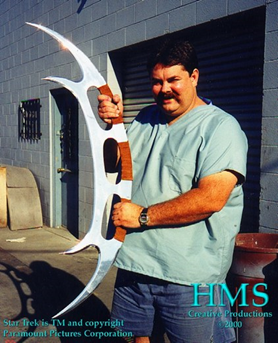
It especially means that I wouldn’t try to rob a store with a Bat’leth that is too small for even a child Klingon warrior to use:

image

Now, this is a bat’leth that you might be able to rob a store with:
image

(Image credit) (Image credit)

What if the real world was like the Matrix?

February 4th, 2009 · 8:00 am  →  Blog

My friend J Zhang found this online and I just had to re-share it. I love the Japanese people (Japanese Human Art via NOOB.us):